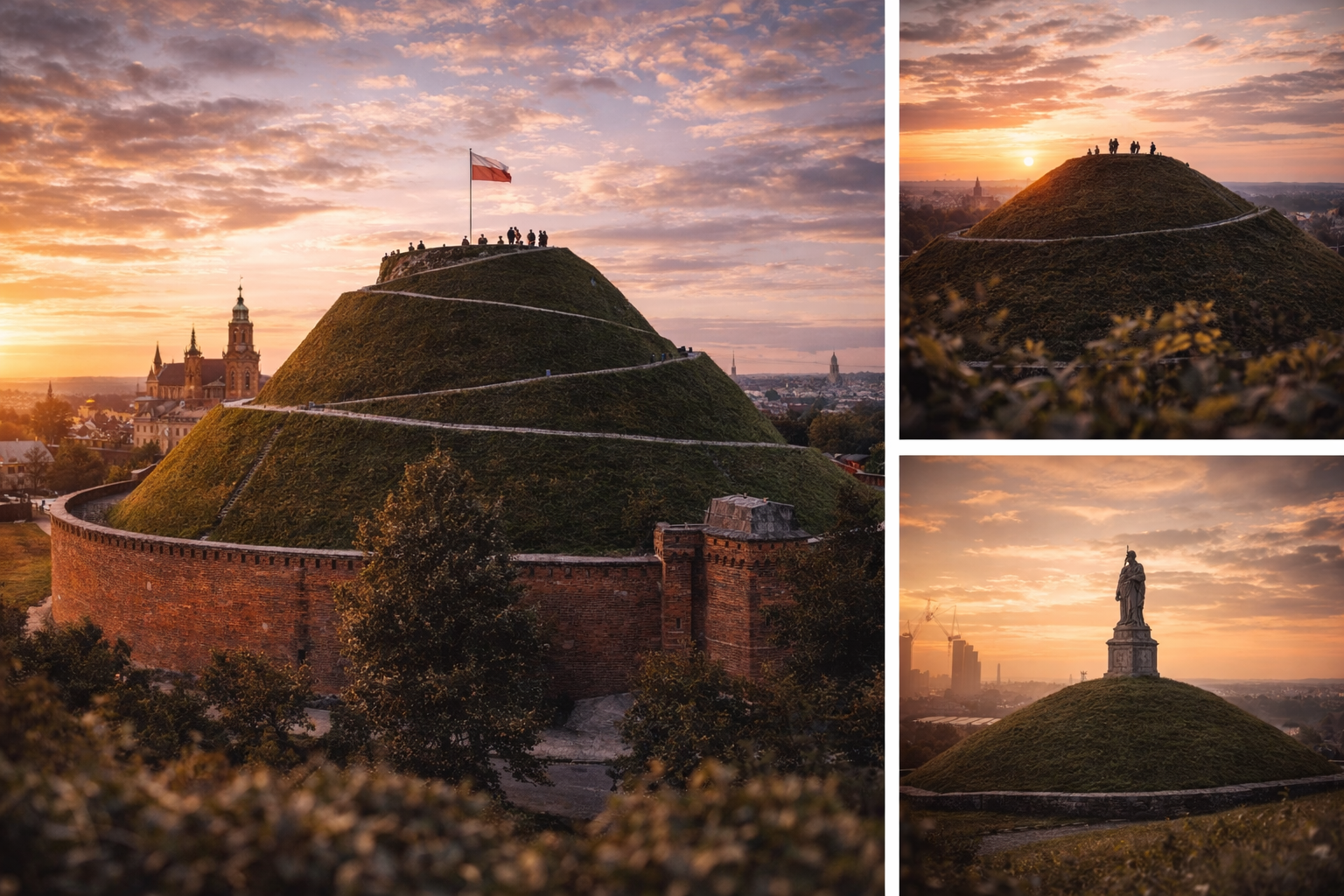
For centuries, Kraków has been called the heart of Polish history — the spiritual capital of the nation and a city where the past and present form a coherent whole. Among the many monuments that attract millions of visitors each year, the Kraków mounds stand out as particularly unique – monumental earthworks towering over the city’s skyline.
For some, they are merely scenic viewpoints; for others, they serve as national memorials or even mysterious relics of ancient times whose meaning has not yet been fully understood. Why are there so many of them in Kraków? What do they symbolize, and what stories lie buried within their slopes? The answers lead deep into Polish history — from the legendary beginnings of the nation, through the time of partitions, to modern times.
The Oldest Mounds – Traces of Prehistory and Legend
The most famous and oldest mounds in Kraków are the Krakus Mound and the Wanda Mound. According to legend, the former was erected in honor of the city’s legendary founder, Prince Krakus, who is said to have slain the Wawel Dragon and established the first settlement at the foot of Wawel Hill. The latter, smaller mound located in Nowa Huta, commemorates his daughter Wanda, who – as the legend goes – threw herself into the Vistula River rather than marry the German prince Rydygier.
Archaeological research confirms that the Krakus Mound indeed dates back to pre-Christian times, probably the 7th or 8th century, making it one of the oldest structures of its kind in Central Europe. Inside, archaeologists discovered burial remains, pottery fragments, and traces of fires — all of which suggest a ritual or cultic purpose. Scholars believe that this mound may have served as a ceremonial site connected to ancestor worship or astronomical observations, similar to Stonehenge in England.
The Wanda Mound, though smaller, also holds many secrets. Its legend symbolizes self-sacrifice and love for one’s homeland, which over time turned it into a powerful national symbol, especially during the periods when Poland lost its independence.
Modern Mounds – Monuments of National Memory
After many centuries of silence, the tradition of mound building was revived in the 19th century. During the partitions of Poland, when the nation had no state of its own, the idea emerged to create monumental symbols of national identity. In 1820, construction began on the Kościuszko Mound, dedicated to the hero of liberty — Tadeusz Kościuszko.
For three years, thousands of people from across Poland — nobles, peasants, students, and townsfolk — carried soil from famous battlefields such as Racławice and Maciejowice to build a mound as a symbol of national unity. The Kościuszko Mound became a site of patriotic pilgrimage and a powerful manifestation of Polish identity during the partitions. From its summit, one can see the entire panorama of Kraków — a symbolic reminder that Kościuszko’s spirit still watches over the city.
A century later, after Poland regained independence, another monumental mound was built — the Piłsudski Mound, also known as the Mound of Independence. Constructed in the 1930s in the Wolski Forest, this mound was formed from soil brought from battlefields where the Polish Legions fought. It symbolized the rebirth of the Polish state and the unification of the nation after years of foreign domination.
Symbolism and Spiritual Continuity
Although Kraków’s mounds were built in different eras and for different reasons, they share a common thread — they all serve as symbols of memory, continuity, and national identity. They are not merely monuments to individual figures or events but living testaments to the resilience of the Polish people throughout history.
The construction of the Kraków’s mounds has always coincided with turning points in Polish history – from the mythical beginnings, through the partitions, to the rebirth of independence.Each mound is like a layer of collective memory, laid down by generations wishing to leave a lasting mark.
Some researchers also point to the cosmic and sacred symbolism of these structures — their alignment with the sun, the river, and Wawel Hill may not be accidental. There are even hypotheses that the mounds form an astronomical alignment system, where the lines connecting them might correspond to ancient ritual pathways.
The Mounds in Culture and the Modern Era
Today, Kraków’s mounds are not just historical relics or scenic overlooks. They are living spaces, still playing a vital role in the city’s cultural and social life. Modern patriotic ceremonies, historical reenactments, and memorial events often take place there.
In recent years, the routes connecting the mounds have been revitalized to form the Trail of the Four Mounds — not only a tourist attraction but also a symbolic journey through Polish history, from the legendary times of Krakus and Wanda to the heroes of modern independence. From the summits of these mounds, one can witness how Kraków has evolved over the centuries — how the ancient royal city intertwines with a modern metropolis without losing its spirit or traditions.
The Kraków mounds are far more than simple hills of earth blending into the city’s landscape. They are monuments of memory, faith, and identity, linking the past with the present. They stand as proof that a nation capable of creating such symbols has never lost its sense of unity or pride in its history.
From legendary heroes to modern patriots — each mound tells a different story, yet together they form a map of Polishness, deeply rooted in the land and in the hearts of its people. Standing atop them, one can feel not only the beauty of Kraków but also a profound sense of continuity between generations. The mounds — like Kraków itself — remind us that history is not merely a record of the past but a living part of who we are.