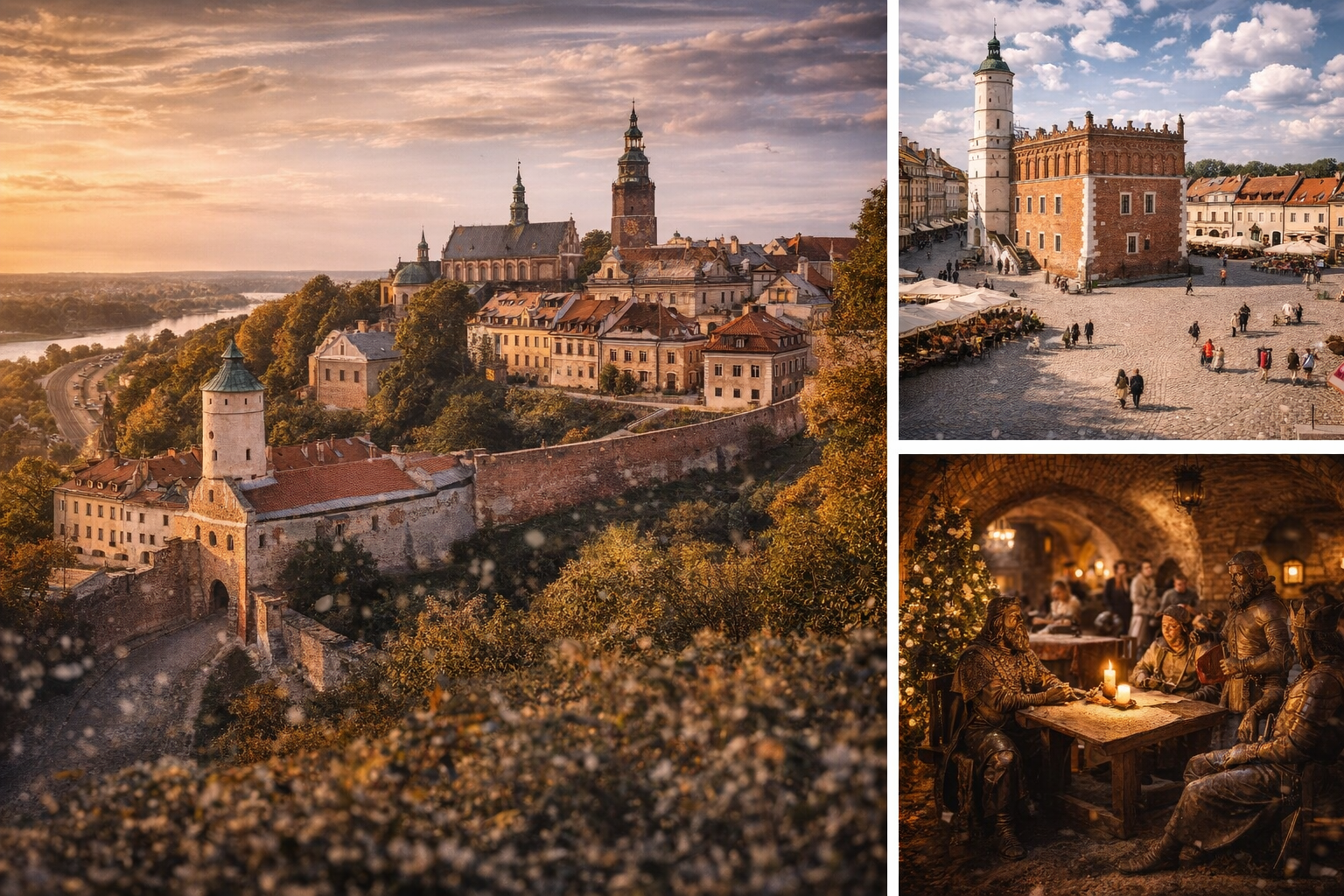
On the map of Poland, there are towns which, despite their seemingly small size, have played—and continue to play—a major role in the nation’s history. One of them is Sandomierz—picturesquely situated on the Vistula River, at the junction of the Sandomierz Upland and the Świętokrzyskie Mountains. Although today it has only several thousand inhabitants, for centuries it was one of the most important political, economic, and religious centers in Poland. Its history mirrors that of the entire country—from the early Piast period of growth, through dramatic invasions and partitions, to the modern era, in which Sandomierz harmoniously combines its historical heritage with modernity.
Sandomierz – One of the Oldest Strongholds in Poland
The beginnings of Sandomierz date back to pre-Christian times. As early as the 9th century, there was a tribal stronghold here whose strategic location on the Vistula River made it a key point on the trade route linking Pomerania, Ukraine, and Hungary. After the establishment of the Polish state by Mieszko I and Bolesław the Brave, Sandomierz became one of the main administrative centers of the young kingdom. In The Polish Chronicle by Gallus Anonymus, it is listed among the most important cities, alongside Kraków and Wrocław.
In the 11th century, the first ducal residence was built here. At that time, the town served as the political center of the region later known as the Land of Sandomierz, which played an important role in the formation of the Polish state.
The Golden Age – The Capital of a Duchy and a Spiritual Center
Sandomierz reached its greatest prosperity in the 12th and 13th centuries. After the division of Poland into provinces in 1138, it became the capital of the Duchy of Sandomierz. It was ruled, among others, by Prince Henry of Sandomierz, one of the sons of Bolesław the Wrymouth, who became famous for taking part in a crusade to the Holy Land. After his death, the Sandomierz region was incorporated into the domain of the Kraków princes, while the city itself continued to serve as a political center of Eastern Lesser Poland.
The 13th century brought tragic events—in 1241, the town was almost completely destroyed by the Tatars, and its inhabitants were massacred. The legend of the slaughter of the Dominican monks, commemorated in the relics of the so-called Blessed Sandomierz Martyrs, remains an important part of local religious tradition to this day.
After being rebuilt in the 14th century, during the reign of King Casimir the Great, Sandomierz received Magdeburg rights and was surrounded by city walls. A royal castle, town hall, and numerous churches and monasteries were erected. The city became the seat of a regional court and one of the three main cities of Lesser Poland, alongside Kraków and Lublin.
Sandomierz in the Jagiellonian Era – A City of Sejms and Nobility
In the 15th and 16th centuries, Sandomierz was the site of numerous gatherings of the nobility and national assemblies . In 1570, the Sandomierz Agreement was concluded here—a pact between three Protestant denominations: Calvinists, Lutherans, and the Bohemian Brethren. This unique document of religious tolerance in Europe proved that in Poland, religious disputes could be resolved peacefully.
Sandomierz also became a center of culture and education. A Jesuit college, printing houses, and schools operated here, teaching Latin, rhetoric, and philosophy. Crafts and trade flourished, as important trade routes from Kraków to Ukraine passed through the town.
Decline and the Difficult Times of the Partitions
The city’s golden age came to an end with the wars of the 17th century. Swedish invasions, destruction, and epidemics led to poverty and decline. During the Swedish Deluge in 1655, the royal castle was severely damaged, and many buildings were burned down. After the partitions of Poland, Sandomierz first fell under Austrian, then Russian rule. Despite this, it retained importance as the seat of a diocese and a center of patriotic activity.
During national uprisings, the city’s inhabitants repeatedly supported the struggle for independence. During the January Uprising of 1863, Sandomierz became a hub of underground activity, and its surroundings witnessed numerous skirmishes.
Rebirth and Modern Times
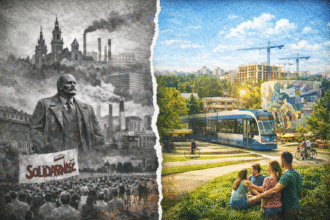
After Poland regained independence in 1918, Sandomierz returned to the country, although it never regained its former administrative significance. In the interwar period, it was a small but vibrant center of culture and tourism. During World War II, German occupiers carried out brutal repressions, and the local Jewish population was almost completely exterminated.
After the war, the city was gradually rebuilt. Today, thanks to its unique location, rich history, and well-preserved urban layout, Sandomierz is one of Poland’s most beautiful “museum towns.” In 2017, its Old Town was inscribed on the list of Monuments of History, confirming its great importance to the national heritage.
Modern Sandomierz is also a popular tourist destination, known, among other things, from the TV series Father Mateusz. Although this media fame attracts thousands of visitors, the town remains above all a place of exceptional identity—combining history, culture, and spirituality.
Sandomierz is an example of a town that, despite its small size, played a monumental role in Polish history. It witnessed the birth of statehood, endured bloody invasions, became a center of the Reformation, and gave rise to the idea of religious tolerance. It survived decline and partitions, only to become today a symbol of continuity, heritage, and national memory.
“The great history of a small town” is not just a slogan—it is a living reality that Sandomierz confirms at every step: in the walls of its cathedral, in the Gothic cellars beneath the market square, and in the silence of the Vistula hills. Here, within a small space, one can truly grasp the greatness of Polish history.