Kraków – a city of royal heritage, rich in monuments, legends, and a unique atmosphere – is famous for many traditions. One of the most distinctive, yet surprisingly young compared to the centuries-old customs of Christmas, is the Kraków Nativity Scene (Szopka Krakowska). Although it may seem like this tradition dates back to medieval times, in reality, it emerged only in the 19th century. Since then, these nativity scenes have become a symbol of Kraków itself – a creative expression blending religion, history, and urban architecture into one stunning work of art.
Origins – From Christmas Plays to Cardboard Masterpieces
The tradition of nativity scenes originates from medieval nativity plays, inspired by the story of Christ’s birth. As early as the 13th century, Saint Francis of Assisi introduced living depictions of the Nativity into Christian worship to help the faithful visualize the mystery of Christmas. Over the centuries, these performances evolved in Poland into puppet shows and folk plays, especially popular in the Małopolska region.
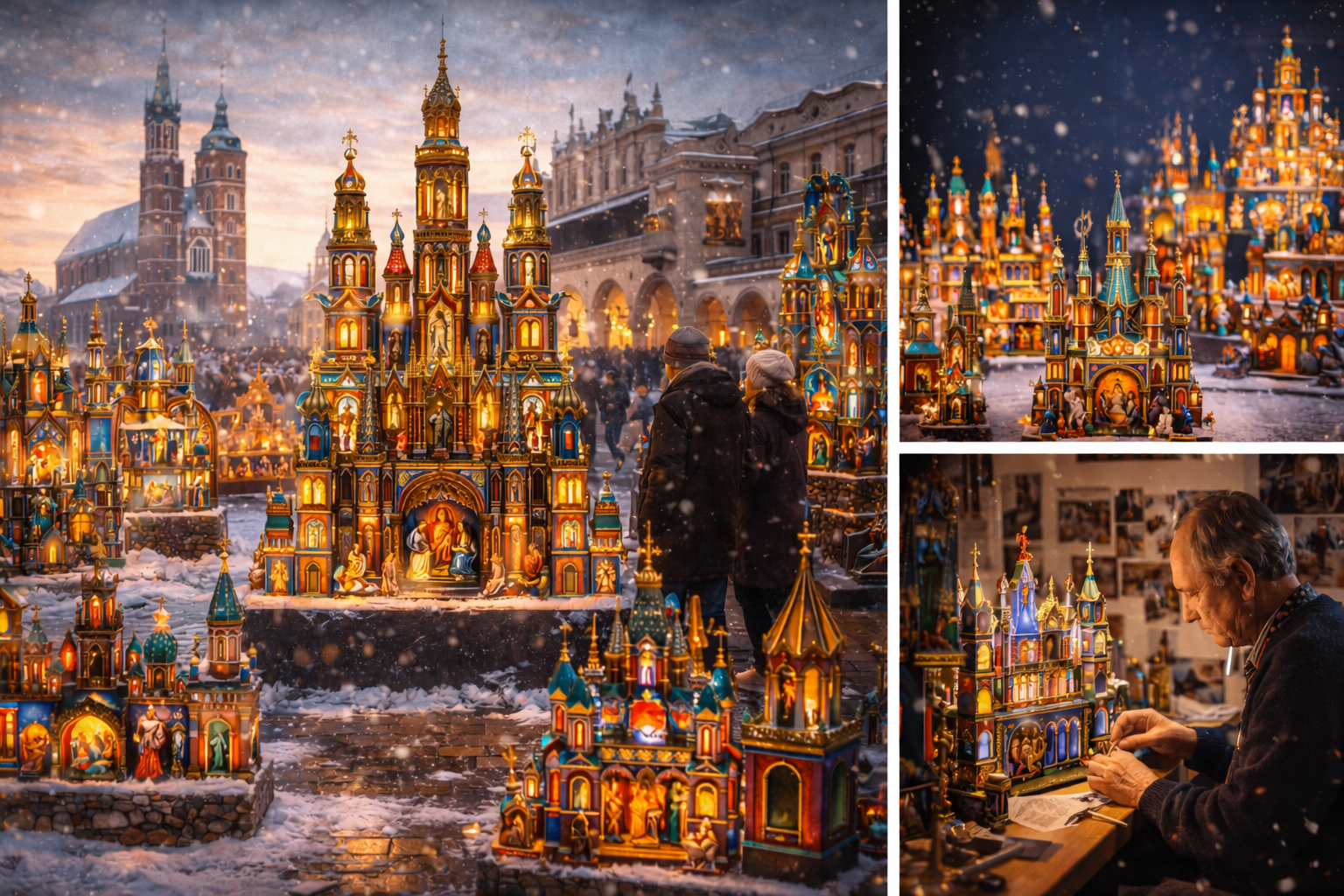
In the 19th century, during the period of the partitions of Poland, a new artistic form appeared in Kraków – the Kraków Nativity Scene. Its creators were mostly craftsmen, builders, and carpenters, who during the winter season – when construction work slowed down – began crafting miniature buildings inspired by Kraków’s architecture. Made of wood, cardboard, colorful foil, and shiny candy wrappers, these lightweight, vibrant creations were initially carried around the city during Christmas caroling. Over time, they became works of art in their own right.
Distinctive Features of the Kraków Nativity Scene
What distinguishes Kraków nativity scenes from traditional Christmas cribs is their form and theme. Instead of depicting a realistic Bethlehem stable, their creators place the Nativity scene within the architectural setting of Kraków’s historic landmarks – churches, castles, and townhouses.
The most common elements include:
- The towers of St. Mary’s Basilica
- Wawel Castle
- The Florian Gate or the Cloth Hall ,
- The Barbican
- Kazimierz architecture
A Kraków Nativity Scene is thus a miniature, fairy-tale version of the city, where the sacred and the secular coexist harmoniously. Alongside the Holy Family, one often finds Lajkonik, the Wawel Dragon, soldiers, townsfolk, Kraków women, and even contemporary figures from local life. In this way, the nativity scene becomes not only a religious object but also a social commentary and artistic portrait of the city.
The Kraków Nativity Scene Contest – A Tradition Since 1937
In 1937, thanks to the initiative of ethnographer Józef Mularczyk, the first Kraków Nativity Scene Contest was held. It has taken place annually ever since (with a break during World War II), on the first Thursday of December. On that day, creators bring their works to the Adam Mickiewicz Monument on Kraków’s Main Market Square, where they are displayed to the public. Later, the scenes are transferred to the Museum of Kraków, where the official judging and exhibition take place.
The contest has become a highlight of Kraków’s Christmas season. Entries are judged in several categories – from tiny, hand-sized scenes to monumental multi-meter constructions. The criteria include originality, artistic quality, adherence to tradition, and the use of architectural motifs characteristic of Kraków.
The Craftsmen – Artists with Passion
Building a Kraków nativity scene requires patience, imagination, and precision. Some artists work on their creations for an entire year, perfecting every tiny detail – from ornate towers to miniature human figures. Today, nativity scenes are made not only from paper and wood but also metal, glass, plastic, and LED lights, adding a magical glow.
Among the most famous masters of this art are Eugeniusz Duda, Tadeusz Gillert, and Janina Madej, whose works have won awards and been exhibited both in Poland and abroad. These craftsmen pass their skills down through generations, ensuring that the tradition continues to evolve while remaining alive and authentic.
Kraków Nativity Scenes in Global Culture
In 2018, the tradition of building Kraków Nativity Scenes was inscribed on UNESCO’s Representative List of the Intangible Cultural Heritage of Humanity. This was a major recognition for Kraków, confirming that what began as a local artistic practice had become a cultural treasure of global importance. Today, these nativity scenes can be admired not only in the Museum of Kraków but also at exhibitions across Poland, Europe, and the United States.
They have also become a symbol of Kraków’s creativity and identity, often used in the city’s cultural promotion. Contemporary artists continue to draw inspiration from this tradition, creating multimedia or interactive versions that blend the old with the new.
The Kraków Nativity Scene is a unique cultural phenomenon – a relatively young, less-than-two-hundred-year-old tradition, that has achieved the status of a national treasure. It combines the spirit of Christmas, the artistic genius of Kraków’s citizens, and pride in local history. The tradition continues to evolve, yet it never loses its charm – still dazzling with its color, craftsmanship, and the warmth of human creativity.
When the bright, shimmering nativity scenes appear each winter on Kraków’s Main Square, one can feel that the magic of Christmas is awakening once again – a magic that unites generations, art, and faith into one extraordinary work of beauty.