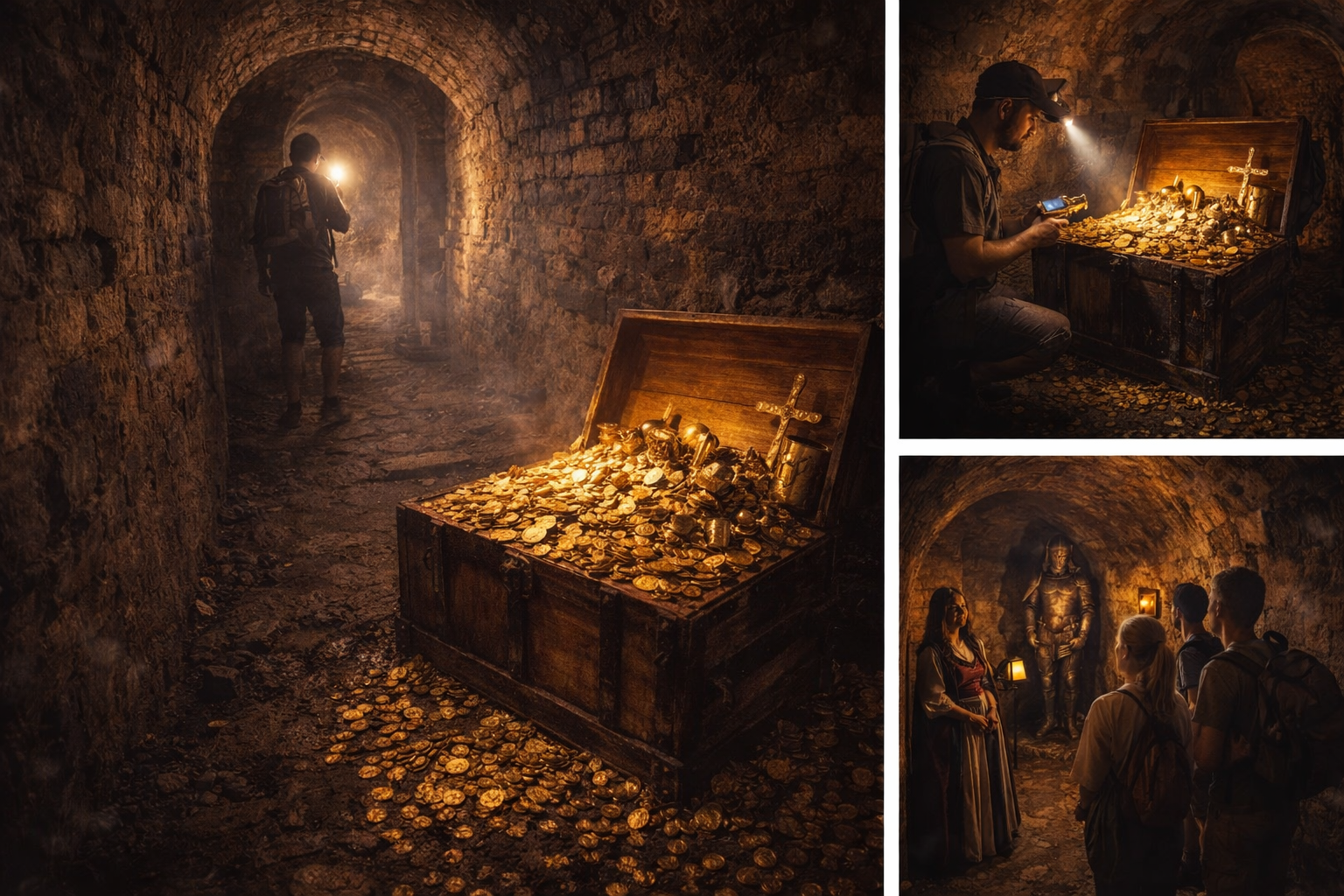
Sandomierz – a town located on loess hills above the Vistula River – has been surrounded by an aura of mystery for centuries. Often called the “Little Rome”, Sandomierz attracts not only tourists but also lovers of history, archaeology, and enigmas. Among the many stories told about this ancient city, one of the most fascinating is the legend of gold hidden beneath the market square. Could there really be treasure buried within the maze of cellars, tunnels, and old merchant chambers? Or is it merely a legend that has grown in the imagination of Sandomierz’s residents over the centuries?
The Underground of Sandomierz – History and Function
Before exploring the legend itself, it’s worth understanding what the Sandomierz underground actually is. The network of tunnels and cellars beneath the market square and surrounding buildings dates back to the Middle Ages. Originally, these underground spaces served as merchant warehouses – where goods such as salt, wine, honey, cloth, and spices were stored. Thanks to its thriving trade with Kraków, Lviv, and Gdańsk, Sandomierz became one of the most important commercial centers in Lesser Poland.
Over time, as new cellar levels were added and the city’s surface gradually rose due to landslides and reconstruction, an extensive network of underground corridors emerged. Today, this system stretches over 470 meters and is open to visitors as the Underground Tourist Route named after Queen Jadwiga. During wars and sieges, the same tunnels provided shelter for residents, and some sections even led beyond the city walls.
The Birth of the Legend of Hidden Gold
The legend of the Sandomierz gold likely originated in the 17th century, during a time of wars, fires, and plundering. According to one version of the story, when Swedish troops approached the city during the Deluge (1655–1660), local merchants hid their valuables and coins in the underground chambers beneath the market square, hoping to retrieve them after the war. Unfortunately, many of them died or were forced to flee, leaving their treasures behind.
Another version attributes the hidden gold to monks who feared confiscation or looting by invading forces. They allegedly transferred the monastery’s wealth into the underground tunnels that connected religious buildings with the market square. Some historical accounts even mention secret corridors stretching from the Church of St. James all the way to the city center – though no definitive evidence of their existence has ever been found.
Archaeology vs. Legend
Modern archaeological and historical research sheds some light on the story of the supposed hidden gold. In the 1970s, during restoration and reinforcement work in the underground, numerous artifacts were discovered – fragments of pottery, tools, pieces of jewelry, and coins from various eras. However, no significant treasure was ever found.
Researchers believe the gold may never have existed, and that the tales arose from the fascination with the mysterious tunnels and the city’s rich history. Still, archaeologists admit that not all parts of the underground system have been explored. Many passages remain inaccessible due to safety concerns or lack of documentation.
These unexplored areas keep the legend alive. Each time a new section is discovered or an old building is renovated, excitement rises anew – perhaps this time the gold will be found.
Gold as a Symbol – What the Legend Really Means
Whether or not actual treasure lies beneath Sandomierz, the legend of the hidden gold carries a symbolic meaning. In many folk tales, gold represents not only material wealth but also spiritual and cultural richness – the treasure of memory and tradition.
Perhaps, then, the “gold of Sandomierz” is a metaphor for the city’s extraordinary heritage. Its old townhouses, cobbled streets, Gothic and Renaissance churches, and the lingering spirit of past centuries – all these are part of a treasure that has survived through time. In that sense, the legend isn’t about buried wealth but about the deep, enduring richness of the city itself.
The Underground Today – A Tourist Mystery
Today, the Sandomierz underground is one of the region’s main tourist attractions. The route includes 34 chambers and descends up to 12 meters below the surface of the market square. Visitors can admire historical exhibits and reconstructions of old merchant interiors, while guides tell stories about the city’s secrets and legends.
One of the most popular tales shared during tours is that of Halina Krępianka – a Sandomierz heroine who sacrificed her life to save the city from the Tatars by luring the invaders with her into the tunnels and sealing them inside. Her story is often linked with the motif of hidden treasures – as a symbol of courage, sacrifice, and devotion.
So, is there really gold hidden beneath the market square of Sandomierz? The answer remains uncertain. The absence of archaeological proof doesn’t necessarily mean the legend is false – history knows many cases where treasures were found after hundreds of years. Yet even if no gold was ever there, the legend itself is a priceless part of Sandomierz’s identity.
It fuels curiosity, connects generations, and keeps the city’s mysterious spirit alive. Because when you descend into the cool, stone corridors beneath the market square, you can still feel the thrill of adventure and imagine that beneath your feet lies gold – perhaps not in chests, but in the city’s stories, legends, and living memory.