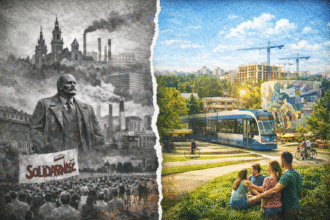
The roots of Wrocław’s dwarfs go back to the 1980s, when Poland was under communist rule, and society increasingly expressed dissatisfaction with the authorities. Wrocław was one of the centers of opposition, and one of the most unusual protest movements was the Orange Alternative—a group of young artists and students who resisted the system in unconventional ways.
The founder of the Orange Alternative was Waldemar “Major” Fydrych, who came up with the idea of covering anti-government slogans, painted over by the police, with images of dwarfs. The authorities would erase the slogans of “Solidarity,” and in their place appeared smiling, orange dwarfs. The campaign was both provocative and humorous—the authorities did not know how to respond to such absurd forms of protest.
Over time, the dwarf became a symbol of freedom of expression and resistance through humor. In the Orange Alternative happenings, hundreds of people wore orange hats, and Wrocław became a place where street art and opposition merged in a unique form.
From Graffiti to Sculpture – The Birth of Modern Dwarfs
After the fall of communism, the idea of dwarfs took on a new life. In 2001, thanks to the initiative of the city authorities and artist Tomasz Moczek, a graduate of the Wrocław Academy of Fine Arts, the first dwarf figurine – Papa Dwarf – was installed. It commemorated the Orange Alternative and its activities during the communist era.
Papa Dwarf can be found on Świdnicka Street—a symbolic location where the famous happenings took place. From that moment, the “dwarf era” in Wrocław began.
In the following years, more figurines appeared—each with a unique appearance, personality, and story. Some were sponsored by companies, universities, cultural institutions, and even private individuals. Dwarfs became a way to express identity, humor, and creativity.
Dwarfs Today – Between Tradition and Modernity
Today, Wrocław is home to over 600 dwarfs, and their number continues to grow. They can be found almost everywhere—on the Market Square, Ostrów Tumski, Słodowa Island, in the Nadodrze and Ołbin districts, and even on the city’s outskirts. Each dwarf has its own name and story, often connected to its location.
For example:
Syzyfki on Świdnicka Street symbolize the effort and struggle in everyday life.
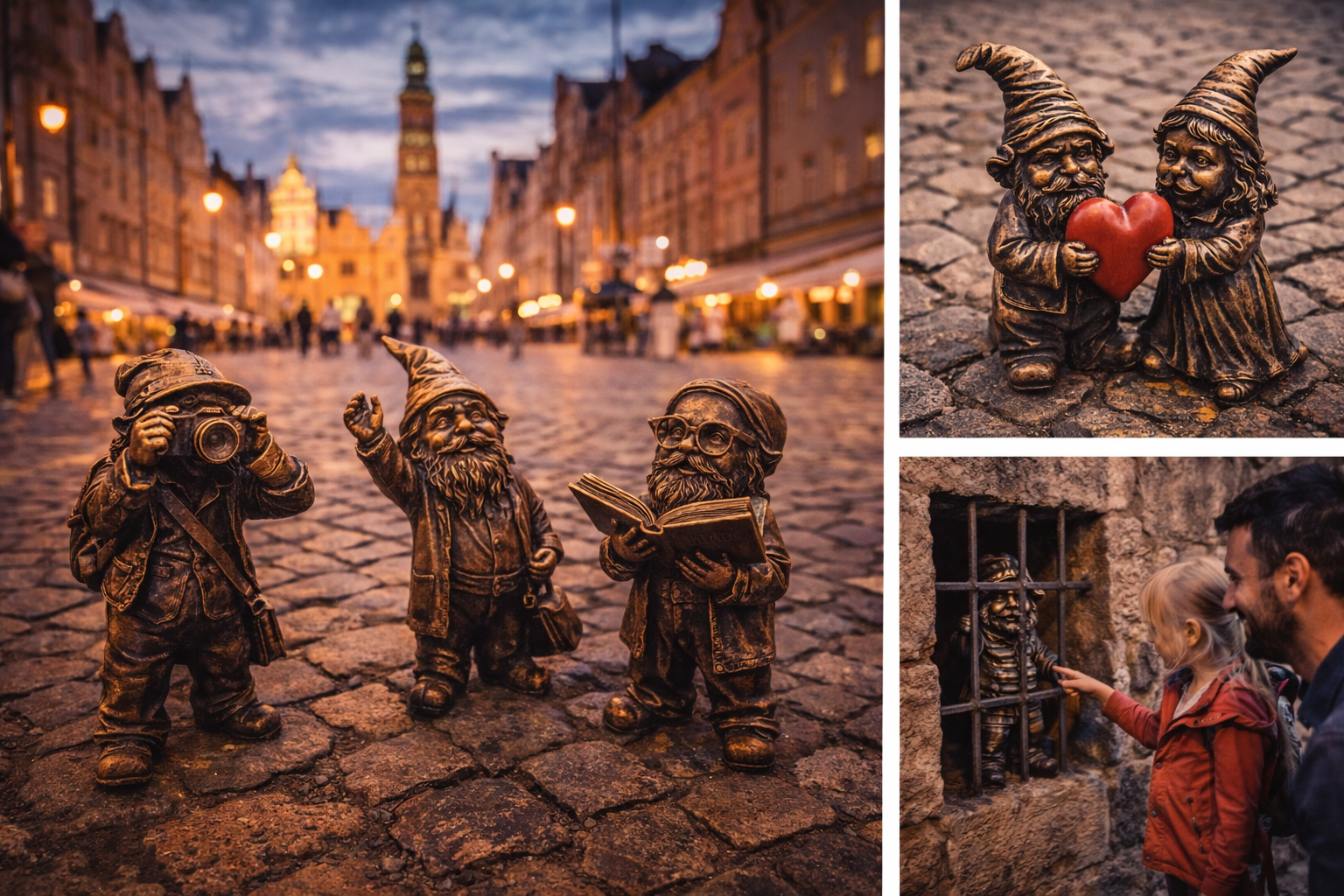
Prisoner in front of the detention center on Sądowa Street reminds us of the fate of people imprisoned during the communist era.
Wroclovek and Wroclovka on the Market Square embody the love and hospitality of Wrocław’s residents.
Professor at the University of Wrocław honors scientists and students who contribute to the academic tradition of the city.
Wrocław’s dwarfs have ceased to be merely decorative; they are now an integral part of the city’s identity, proudly promoted with the slogan “City of Dwarfs.”
Dwarf Tourism – Fun, Education, and City Promotion
The phenomenon of dwarfs quickly caught the attention of tourists. Today, exploring Wrocław often involves searching for them—special maps, mobile applications, and themed trails like the Wrocław Dwarfs Trail have been created.
Families with children treat it as a city-wide game, while older tourists see it as an unusual way to discover the city’s history. The city also regularly organizes events related to dwarfs, such as Dwarf Day, featuring urban games, competitions, and art workshops.
Dwarfs have also become a powerful marketing tool. Their images appear on souvenirs, gifts, t-shirts, and posters. They are a recognizable symbol of Wrocław, much like the Mermaid for Warsaw or the Wawel Dragon for Kraków.
The Secret of Their Popularity
Why have dwarfs gained such extraordinary popularity? Their appeal lies in their universality and closeness—everyone can find something in them. They combine humor, history, art, and local pride. They remind us that even the smallest can make a difference, both in historical context and in everyday city life.
Moreover, dwarfs perfectly fit Wrocław’s spirit—a city that is open, tolerant, multicultural, and creative. Their presence is not only a tribute to the past but also a living, evolving symbol of contemporary urban identity.
The history of Wrocław’s dwarfs is a story of transformation—from a symbol of resistance to a city folklore icon and a global hallmark. Dwarfs teach us that even small gestures—smiles, irony, creativity—can change the world and inspire people to act.
Today, Wrocław without dwarfs would be like Paris without the Eiffel Tower—it would lose something unique that unites residents and attracts visitors. These little figurines, patiently standing on city streets, remind us that freedom, humor, and art can go hand in hand.