For centuries, Krakow has held a special place on the spiritual map of Poland. The former royal capital—long the center of power, learning, and culture—is also a city with an exceptionally rich religious tradition. Within its borders stand over 120 churches and chapels, many of which are not only architectural treasures but also vital centers of spiritual life, pilgrimage, and worship. In Krakow, history and faith intersect in a unique way—from medieval cathedrals to modern sanctuaries that attract the faithful from around the world.
The Historical Roots of Krakow’s Religiosity
The roots of Krakow’s religiosity reach back to the very beginnings of the Polish state. In the 10th century, when Mieszko I accepted Christianity, the process of Christianization began, and Krakow quickly became one of its key centers. In the year 1000, during the Congress of Gniezno, a bishopric was established here, which played a crucial role in the development of the Polish Church for centuries.
At the heart of Krakow’s religious life stands Wawel Cathedral—the site of coronations and burials of kings, bishops, and national heroes. The cathedral, blending Romanesque, Gothic, and Baroque elements, is not only an architectural masterpiece but also a symbol of the nation’s spiritual continuity. Among those buried in its crypts are Saint Stanislaus, the patron saint of Poland, as well as Adam Mickiewicz, Tadeusz Kościuszko, and Marshal Józef Piłsudski.
Churches – Witnesses of History and Faith
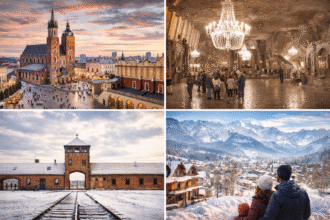
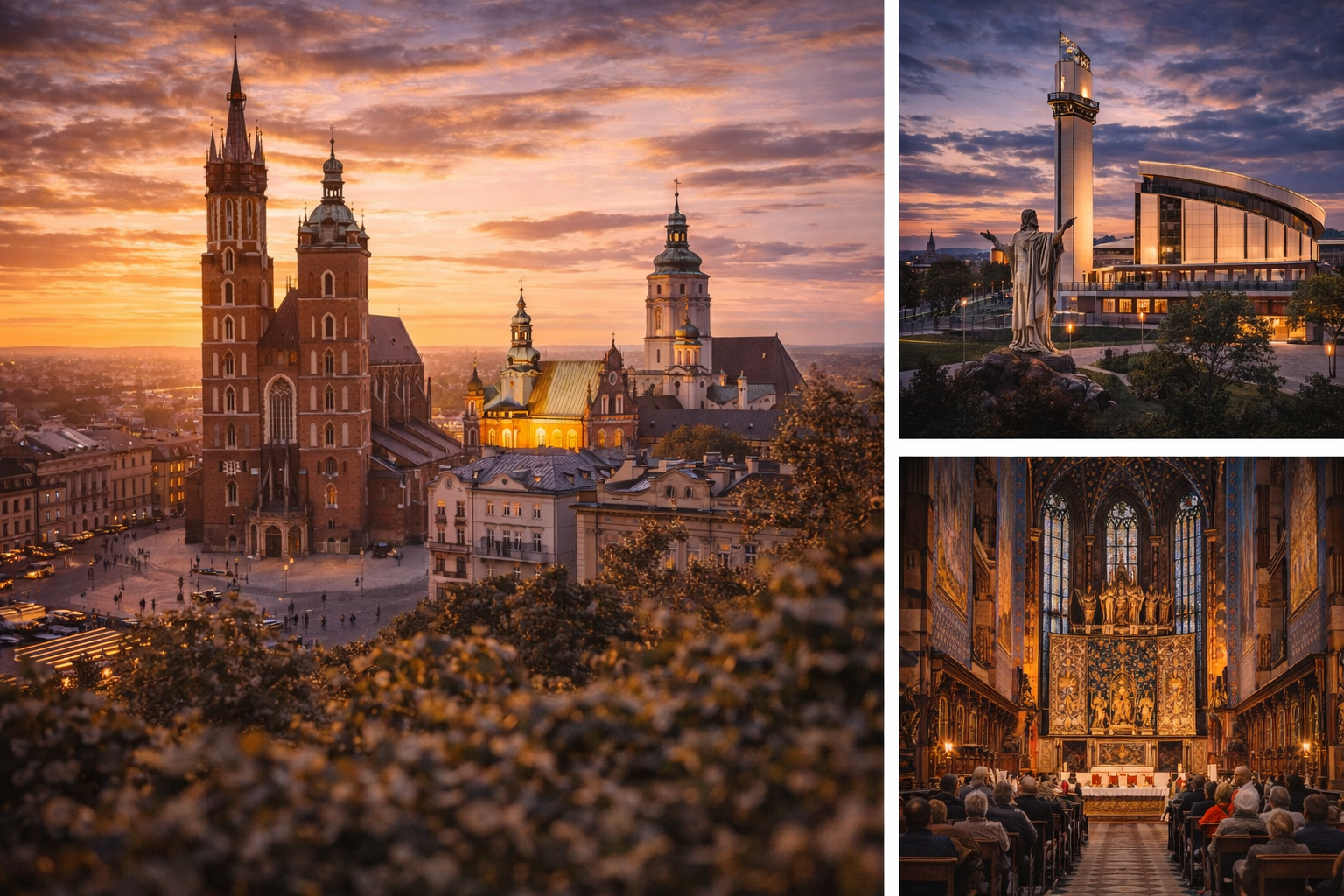
The churches of Krakow are like a chronicle of its history—each telling its own story. In the very heart of the city, at the Main Market Square, stands St. Mary’s Basilica, one of the finest examples of Gothic architecture in Poland. Its two unequal towers have become an unmistakable symbol of Krakow, while its interior houses the monumental altar by Veit Stoss, a masterpiece of religious art of incomparable value. Every hour, the famous St. Mary’s Trumpet Call—sounds from the higher tower, marking the passage of time in the life of the city.
Nearby stands St. Adalbert’s Church, one of Krakow’s oldest, dating back to the 11th century. The modest rotunda on the Market Square recalls the earliest days of Christianity in Lesser Poland. Also notable is St. Anne’s Church, a Baroque gem and the main academic church of the city, closely connected with the Jagiellonian University. Here prayed generations of students and professors, including Nicolaus Copernicus and Karol Wojtyła.
In the historic district of Kazimierz, once the center of Jewish life, stands Corpus Christi Church, founded by King Casimir the Great. Its vast interior and richly decorated design make it one of the most impressive examples of Gothic architecture in the region.
Sanctuaries – The Spiritual Heart of Modern Krakow
Alongside its historic churches, Krakow is also home to numerous sanctuaries that serve as major pilgrimage destinations. Of particular importance is the Sanctuary of the Divine Mercy in Łagiewniki, one of the most significant centers of worship in the world. It was here that Saint Faustina Kowalska lived and died—the nun whose visions of Divine Mercy inspired a global spiritual movement. The modern basilica, consecrated by Pope John Paul II in 2002, welcomes millions of pilgrims every year.
Nearby stands the Sanctuary of St. John Paul II, built in honor of the Polish pope. Its monumental architecture and rich symbolism pay tribute to the man who set out from Krakow to change the face of the Church and the world. The sanctuary houses precious relics, including the blood-stained cassock worn by John Paul II during the 1981 assassination attempt.
Also worthy of mention is the Sanctuary of Our Lady in Mogiła, run by the Cistercian order. It is one of the oldest pilgrimage centers in Poland. The miraculous crucifix venerated there has drawn the faithful since the 13th century, and the monastery itself remains a living testimony to the monastic rhythm of prayer and work through the ages.
Krakow – A City of Prayer, Culture, and Tradition
What makes Krakow truly unique is its ability to harmoniously blend the sacred and the cultural. Its churches are not only places of worship but also spaces for art, music, and reflection. Many of them, such as St. Catherine’s Church or Sts. Peter and Paul’s Church, host concerts of classical music, transforming their interiors into spaces of both spiritual and artistic experience.
Krakow’s religious traditions further enrich its atmosphere: the Corpus Christi processions, the Midnight Mass in St. Mary’s Basilica, or the Passion plays in Mogiła—all remind visitors that faith continues to shape the rhythm of the city. Despite modernity and the bustle of tourism, Krakow retains its spiritual identity, remaining a place where history and belief coexist in harmony.
Krakow is rightly called “the city of churches and sanctuaries.” Nowhere else in Poland is the continuity of Christian tradition so vividly preserved. From Gothic cathedrals and Baroque chapels to modern sanctuaries, every corner of Krakow bears witness to a living faith intertwined with the nation’s history and culture.
The city stands not only as a treasure chest of architecture and art but also as a living testament to spirituality that transcends centuries. Krakow is a place where the sacred meets the everyday—and where the sound of the St. Mary’s trumpet call reminds all who listen that the city’s soul still beats in harmony with faith.